The fastest way to add 'Build a Website in a Day' to your services

- The Blueprint of a Winning Portfolio: A checklist of the five essential elements every social media manager’s portfolio needs to convert visitors into paying clients—focusing on measurable case studies, multi-platform content samples, clear services, social proof, and seamless contact options.
- 5 Real-World Portfolio Examples (With Actionable Takeaways): A breakdown of five distinct, successful portfolio styles, including Case Study-Led, Niche-Specialist, Visual-First, Social-First Bio Link, and Metrics-Obsessed, explaining exactly why they work and what strategies you can "steal" from them.
- How to Build Your Portfolio Fast Using Julip: A step-by-step guide to setting up a professional, "website-in-bio" portfolio in under an hour using Julip, including how to structure your bio, services, testimonials, and discovery call booking links.
- Expert Answers to Burning FAQs: Clear, practical answers to common industry questions, including how to build a portfolio with zero experience using spec work, where to host your portfolio, and why traditional formats like PDFs or Google Drive folders are losing you clients.
You know that moment when a potential client says "can you send me some examples of your work" and you scramble to throw together a Google Drive folder full of screenshots, a six-month-old PDF or Canva, or a Linktree with links that lead absolutely nowhere useful?
That moment costs you the job. A strong social media manager portfolio does not just show what you have done. It shows how you think, what results you actually drive, and why someone should pick you over the next person sitting in their inbox.
This article covers real social media manager portfolio examples, what each one includes, why it works, and what you can take from it. By the end, you will also have a clear, practical path to building your own social media portfolio fast, without needing a web designer or a complicated website setup.
What Every Social Media Manager Portfolio Needs to Include
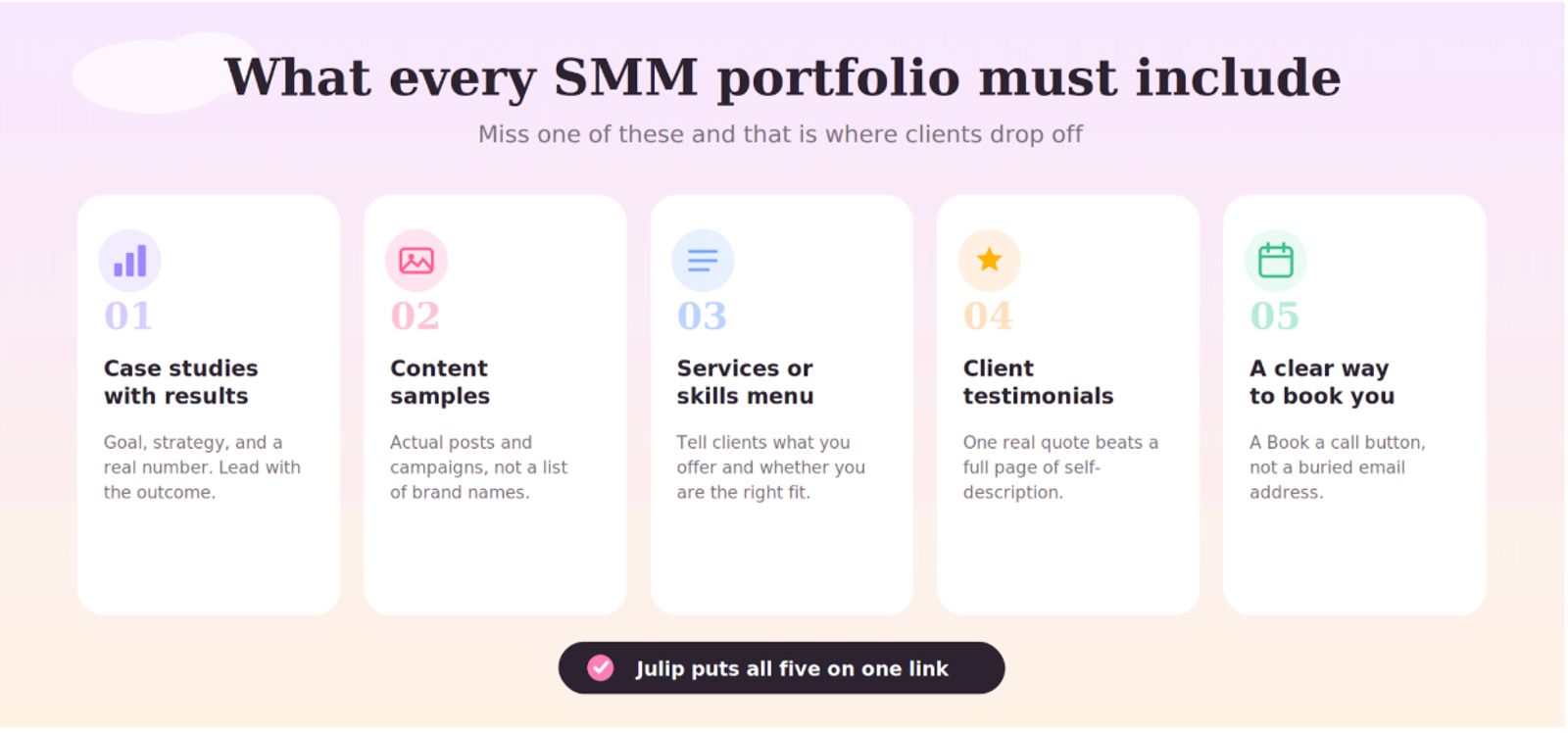
Before diving into the examples, here is a quick checklist of what a strong portfolio must have. If yours is missing any of these, that is likely where clients are dropping off.
- Case studies with measurable results: Not just "I managed Brand X's Instagram." Show the goal, the strategy, and the outcome. Follower growth percentage, engagement rate lift, reach, conversions. Numbers make you credible. Vague descriptions do not.
- Content samples across platforms: Clients want to see actual posts, campaigns, and creative you have produced, not a list of brand names. Include screenshots or embeds from Instagram, TikTok, LinkedIn, or wherever your work lives.
- A clear services or skills section: What do you actually offer? Strategy, content creation, community management, paid social, analytics? This section tells a potential client immediately whether you are the right fit, saving everyone time.
- Client testimonials: Social proof is especially powerful in social media management, where results can be hard to verify at a glance. Even one strong testimonial from a real client carries more weight than a full page of self-description.
- A clear way to book or contact you: The portfolio's job is to convert a visitor into an enquiry. A "Book a call" button or a clean contact section, not a buried email address, is what turns a viewer into a paying client.
5 Social Media Manager Portfolio Examples (And What Makes Them Work)
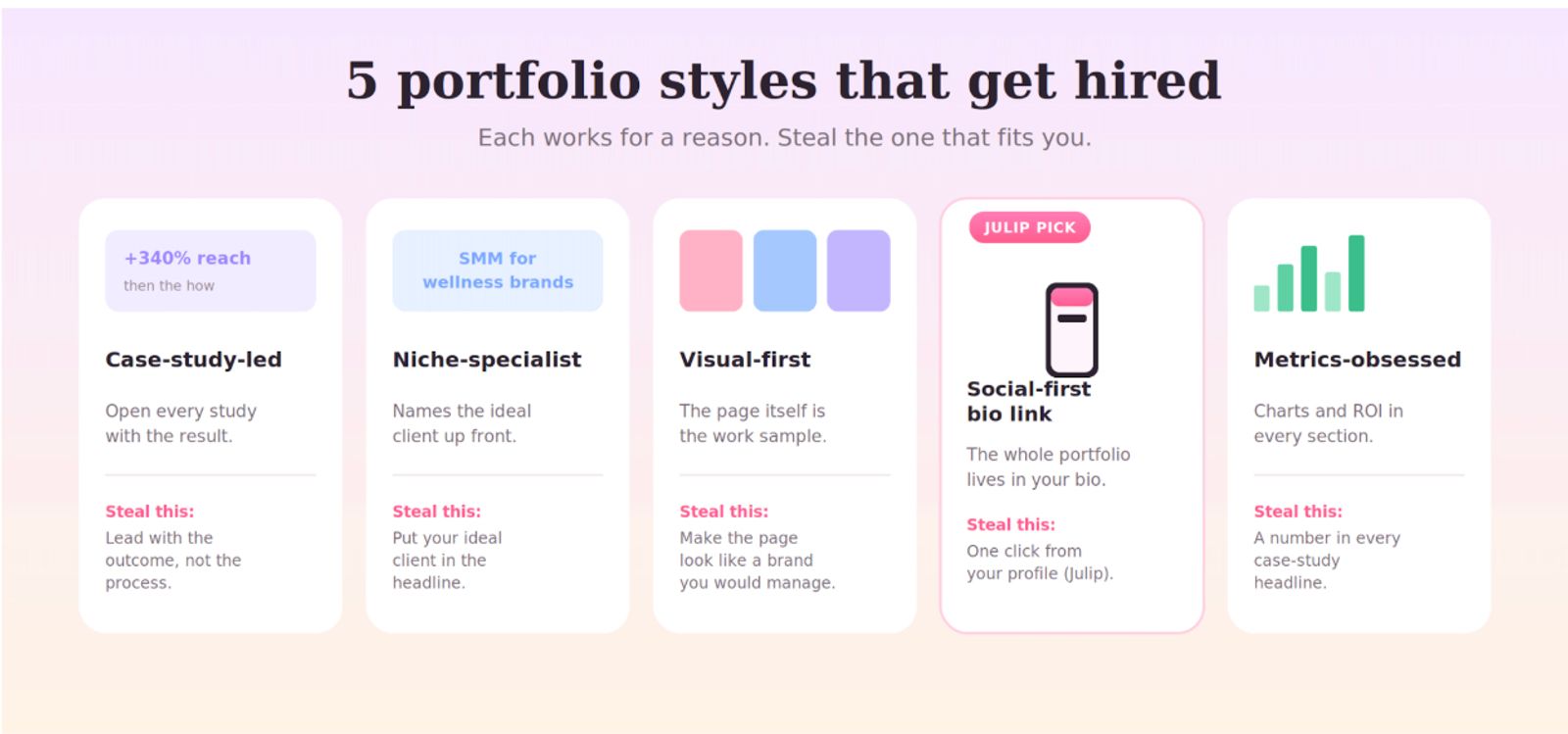
Here are five real social media portfolio examples, each demonstrating a different strength, with notes on what you can actually take and use.
Example 1: The Case Study-Led Portfolio
Who they are: Jasmine Star is a social media strategist and educator whose portfolio and website prominently feature detailed campaign-level work, platform-specific results, and a clear articulation of her process.
What it includes: In-depth case studies with real metrics, platform-specific content samples, a clearly defined services list, and multiple ways to get in touch or book a call.
What makes it work: Every case study leads with a specific outcome before explaining how it was achieved. A potential client skimming the page immediately understands the value being offered. There is no guessing about what she does or who she helps.
What to steal: Lead every case study with the result, not the process. Clients hire outcomes, not intentions. If your case study opens with "I started by auditing their content calendar," you have already lost half your audience.
Example 2: The Niche-Specialist Portfolio
Who they are: A social media manager who has positioned themselves as the go-to person for a specific industry, say hospitality, wellness, or B2B SaaS, and whose portfolio makes that crystal clear from the first line.
What it includes: Niche-specific case studies, a hero section that names the ideal client directly, content samples from relevant brands, and testimonials from clients within that same industry.
What makes it work: A restaurant owner searching for "social media manager for restaurants" immediately feels like they have found someone who understands their world. Generalist portfolios get overlooked. Niche portfolios get hired. The specialisation does the selling before a client even reads the full page.
What to steal: State your ideal client in your portfolio headline. "Social media manager for wellness brands" gets better enquiries than "social media manager." The more specific you are, the more qualified the leads you attract.
Example 3: The Visual-First, Brand-Driven Portfolio
Who they are: A social media manager whose portfolio is visually striking, with strong personal branding, a cohesive colour palette, bold typography, and a design that itself functions as proof of their creative ability.
What it includes: A bold branded hero section, a grid of content samples, short client win callouts throughout, and a prominent booking or enquiry call to action that is impossible to miss.
What makes it work: The portfolio is evidence of their design and brand sensibility before a client reads a single word. If you manage social media for brands, your own page should look like a brand. A visually poor portfolio sends a signal you do not want to send.
What to steal: Your portfolio is a live sample of your work. Its visual quality signals your professional standard before any case study or testimonial does. If your portfolio looks like it was put together in ten minutes, clients will assume your client work looks the same.
Example 4: The Social-First Bio Link Portfolio
Who they are: A social media manager who builds their entire client base through Instagram or TikTok and uses a single bio link as their primary professional presence, one that functions as a complete portfolio.
What it includes: Visual work samples, a services menu, testimonials, a booking link, and a clear professional bio, all accessible from one URL sitting in their social profile.
What makes it work: Clients arrive from social, so the portfolio lives exactly where those clients already are. There is no separate website to maintain, no domain to renew, no page that goes out of date because you forgot to log in. The bio link is the portfolio. One click from a profile, and a potential client has everything they need to decide.
What to steal: If your clients find you on Instagram or TikTok, your portfolio should be one click away from your bio. A tool like Julip makes this possible without any web design knowledge or technical setup.
Example 5: The Metrics-Obsessed Portfolio
Who they are: A social media manager whose entire portfolio is built around data. Analytics screenshots, before-and-after comparisons, ROI breakdowns, and platform-specific KPIs featured throughout every section.
What it includes: Analytics dashboards, engagement rate comparisons, follower growth charts, and specific campaign ROI figures, all attributed to named or anonymised clients depending on what they have permission to share.
What makes it work: For clients who care about measurable ROI, which is most serious clients, a data-heavy portfolio immediately communicates accountability and strategic thinking. It says: I track everything, I own the results, and I can prove them.
What to steal: Include at least one metric in every case study headline. "Managed social content" tells clients nothing. "Grew TikTok reach by 340% in 90 days" gets you hired.
How to Build Your Social Media Manager Portfolio with Julip
The examples above show what a strong social media portfolio looks like. The next step is actually building one. Most social media managers do not need a complex website. They need a professional, visual page that is live from their bio link and easy to update whenever their work evolves.
If you want to see how other social media managers are already crushing it, take a look at these live Julip pages for inspiration:
- Sir and Amanchez – Great for seeing how to cleanly structure services and client intake.
- Its Maela M – A perfect example of balancing strong, visual content samples with a distinct personal brand.
Why Julip is made for social media managers:
Julip is a visual website-in-bio built specifically for social media managers who get clients through social media.. For social media managers, it is particularly well-suited. You can display case studies and content samples visually, list your services, collect testimonials, add a booking link for discovery calls, and build your email list, all from one page at your bio link. It is the bio link portfolio done the right way (and cute!)
What to set up on your Julip page:
- About/bio section: Who you are, who you help, and what your specialty is. Keep it tight and client-focused.
- Services menu: What you offer and at what level. Think starter, mid-tier, full management.
- Portfolio or case studies section: Three to five examples with real results. Lead with outcomes.
- Testimonials: At least two to three client quotes. Even short ones carry real weight.
- Booking link for discovery calls: Make it easy for someone to take the next step. Free or paid, just make sure the link works.
- Email collector: Start building your prospect list from day one. It is a long-term asset that most social media managers ignore until it is too late.
On speed and setup: No coding, no domain, no hosting to manage. Most social media managers have a Julip portfolio live and linked from their bio in under an hour. The 14-day free trial requires no credit card, so there is genuinely no reason to wait.
FAQ
What should a social media manager portfolio include?
A strong social media manager portfolio should include case studies with measurable results rather than just brand names, content samples across the platforms you work on, a clear services section, at least two or three client testimonials, and a direct way to book or contact you. The goal is to answer three questions for any visitor in under 60 seconds: what do you do, what results do you get, and how do I hire you.
How do I create a social media portfolio with no experience?
Start with spec work. Create mock social media campaigns for two or three brands you admire and present them as case studies with a clear brief, strategy, and content output. Alternatively, offer to manage social for a small local business at a reduced rate in exchange for permission to feature the results. A tool like Julip lets you display this work visually from a bio link without needing a website or any design skills. This approach works well for building a social media portfolio with no experience because it shows strategic thinking even before you have paying clients.
Where should I host my social media manager portfolio?
The best place depends on where your clients find you. If you get clients through Instagram or TikTok, a bio link tool like Julip is the most practical option. Your portfolio is one click away from your profile, with no separate website to maintain. If you want a traditional standalone site, Squarespace and Wix both offer clean templates suited to social media managers. Avoid hosting your portfolio in Google Drive, Canva, or PDF format. Anything that requires a download or a login will cost you clients before they have even seen your work.
Do social media managers need a portfolio website?
Yes, and increasingly, clients expect one. A portfolio website gives you a professional home base that a LinkedIn profile or an Instagram page simply cannot replicate. You control the layout, the narrative, and the call to action. It also lets you include content you cannot post publicly on social media, like anonymised analytics, client case studies, and process breakdowns. Tools like Julip make it possible to have a professional portfolio website live from your social bio in under an hour, with no design or technical knowledge required.
Conclusion
The social media managers who win the best clients are not always the most experienced ones. They are the ones who present their work most clearly and professionally. Every example in this article shares one thing: they make it easy for a potential client to understand the value on offer and take the next step. A portfolio that shows results, includes real testimonials, and has a clear booking link will outperform a Google Drive folder every single time. If you do not have one yet, Julip is the fastest way to build it and get it live from your bio today.